Guide: How to Legally Set Up an Event Radio Station
When investing in high-quality broadcast equipment for an event, it is essential to ensure that all legal requirements are met. In most countries, regulations are strict: broadcasting without the correct permits can lead to heavy fines and the seizure of your equipment.
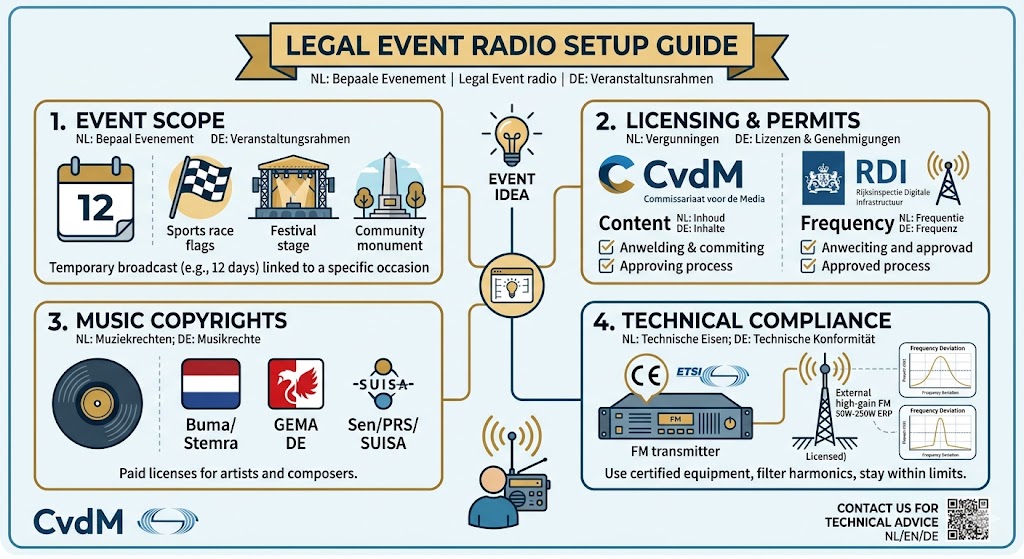
Follow these general steps to get your event station on the air legally.
1. The Basics: What qualifies as an "Event"?
An event broadcast license is typically intended for short-term broadcasts (usually up to 12 days) directly linked to a specific occasion, such as:
-
Sports tournaments or motorsport rallies.
-
Local festivals or community fairs.
-
Commemorations or cultural manifestations.
2. Step 1: Content & Media Authorization
Before applying for a frequency, you often need approval from your national media authority (e.g., CvdM in the Netherlands).
-
Application: You must apply for a temporary broadcasting designation for the specific event.
-
Content: You may be required to show how your programming relates to the event.
-
Fees: Be prepared for administrative processing fees.
3. Step 2: Frequency Allocation & Technical Permits
Once you have media approval, you must apply for a technical broadcast license from the national telecommunications authority (e.g., RDI in the Netherlands or Ofcom in the UK).
-
Technical Parameters: You must specify the transmitter and antenna setup you intend to use.
-
Power & Location: The authorities will assign a specific FM frequency and maximum power level (ERP) to prevent interference with national broadcasters.
-
Lead Time: Apply well in advance (typically 8 weeks before the event).
4. Step 3: Music Copyrights & Royalties
Having a broadcast license does not automatically give you the right to play copyrighted music.
-
Performance Rights: You must obtain licenses from local copyright organizations (such as Buma/Stemra & Sena in NL, GEMA in Germany, or PRS/PPL in the UK).
-
Event Tariffs: Many organizations offer specific, cost-effective short-term licenses for temporary events.
5. Step 4: Technical Installation & Compliance
Ensure your hardware meets international and local standards:
-
Certified Transmitters: Only use equipment with proper certification (such as CE marking) that complies with ETSI standards.
-
Interference Control: Use high-quality filters and shielded coaxial cables to prevent harmonic distortion outside your assigned frequency.
-
Tower Placement: Check local municipal regulations regarding the placement of temporary masts or antennas.
Useful Resources:
-
National Media Authorities (For programming permits)
-
Telecommunications Agencies (For frequency coordination)
-
Copyright Societies (For music licensing)
Expert Tip: Regulatory bodies often perform on-site inspections during events. Always keep your permit documentation near the transmitter and ensure your signal parameters (such as FM deviation/modulation) stay within legal limits.
Need advice on which transmitter or antenna setup is best suited for your licensed power level? Contact us for professional technical advice.