
Products in Dipool FM antennas
-
 € 249,99Dipool FM antennas
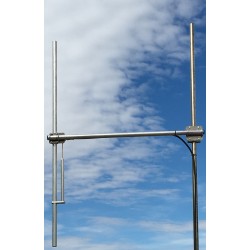
DMR-DP-500 FM Dipole antenna broadband
DMR-DP-500 FM Dipole antenna broadband N Female connector 500W
-
 € 424,99Dipool FM antennas
FM Dipole Antennas wide band breedband FM
These wide band FM antennas, are available in three versions: aluminum, stainless steel or hot dipped steel....
-
 € 484,99Dipool FM antennas
DAB Dipole Antenna wide band BKV/1N-DAB
Label Italy DAB Dipole Antenna wide band BKV/1N-DAB, DIPOLE DAB 200-230Mhz, Aluminium 500W
-
 € 109,99Dipool FM antennas
FM DIPOLE Antenna 87 194 Mhz DP 100
Sirio DIPOOL FM Antenna 87-194 Mhz DP-100 | Sirio, Unity gain, horizontal or vertical polarization....
-
 € 469,99Dipool FM antennas
FM broadcast antenna HIGH GAIN COLINEAR ALUMINUM ¾ Wave
Looking for a solution giving gain similar to 2 bay vertical dipoles with perfect omnidirectional coverage and have...
-
 € 554,99Dipool FM antennas
VHF dab band III broadcast antenna HIGH GAIN COLINEAR ALUMINUM ¾ Wave
VHF DAB band III 175-225 broadcast antenna HIGH GAIN COLINEAR ALUMINUM ¾ Wave
-
 € 559,99Dipool FM antennas
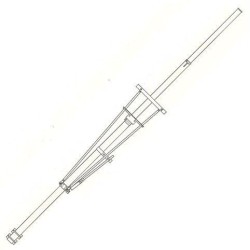
FM broadcast antenna HIGH GAIN COLINEAR stainless steel ¾ Wave
Looking for a solution giving gain similar to 2 bay vertical dipoles with perfect omnidirectional coverage and have...
Information Dipool FM antennas
The dipole FM antenna: Efficiency and reliability in FM radio broadcast
The dipole FM antenna is the undisputed standard for reliable and stable FM broadcasts. Thanks to its simple yet highly effective design, the dipole antenna is the cornerstone of many transmission towers. Whether you choose a broadband variant that covers the entire FM band or a tuned variant that is precisely adjusted to your frequency; the dipole provides the consistent performance that is essential for professional radio broadcasting.
Technical resonance and impedance matching
A standard dipole antenna typically has a length of half a wavelength ($lambda/2$). At this specific length, the antenna achieves resonance, resulting in an ideal connection impedance of 50 Ohms. This value is crucial, as it seamlessly connects to most FM transmitters and broadcast coaxial cables, minimizing reflections and power loss.
- Gain: A half-wave dipole has a theoretical gain of 2.15 dBi (0 dBd).
- Radiation pattern: The dipole radiates in a characteristic "figure-eight" pattern, providing broad coverage on both the front and back sides.
- Symmetrical feed: As a symmetrical antenna, the dipole requires a proper feed. When using asymmetrical coaxial cables, a balun is essential for optimal matching.
Vertical and horizontal polarization
The flexibility of the dipole FM antenna is evident in the mounting options. In the modern broadcasting world, dipoles are usually mounted vertically to ensure optimal reception on car radios and portable receivers. By stacking multiple dipoles on top of each other and connecting them with a power divider, the gain can be significantly increased, pushing the transmission signal further over the horizon.
Durability for long-term broadcasts
Our dipole antennas are made from high-quality materials such as anodized aluminum or stainless steel. This makes them resistant to corrosion, strong winds, and ice buildup. At DMR Electronics, we understand that an antenna is the most vulnerable part of your transmission chain; therefore, we select only models that can operate maintenance-free for years at great heights.
The trusted choice for every broadcaster
From local community radio to larger regional broadcasters: the dipole remains the preferred choice due to its proven efficiency. It is a cost-effective investment that ensures stable signal transmission and a high-quality listening experience. Explore our range and find the right dipole setup for your specific broadcasting needs.
Frequently asked questions about dipole FM antennas (FAQ)
- What is the advantage of a broadband dipole compared to a tuned dipole?
A broadband dipole is immediately usable across the entire FM band (87.5 - 108 MHz) without needing to shorten elements. This is ideal for emergency systems or stations that frequently change frequencies. However, a tuned dipole is often slightly more efficient at that one specific frequency.
- Why should I stack multiple dipoles?
By mounting two or four dipoles on top of each other, the transmission signal is "flattened" vertically. This reduces energy loss to the air and ground, significantly increasing your range over the horizon without needing to increase your transmitter's power.
- How far should a dipole hang from the mast?
The distance to the mast affects the radiation pattern. Usually, a distance of about a quarter wavelength ($lambda/4$) is maintained. This ensures that the mast acts as a reflector, providing a slight forward gain.