DAB+ Band-Pass Mask Filter for VHF Band III
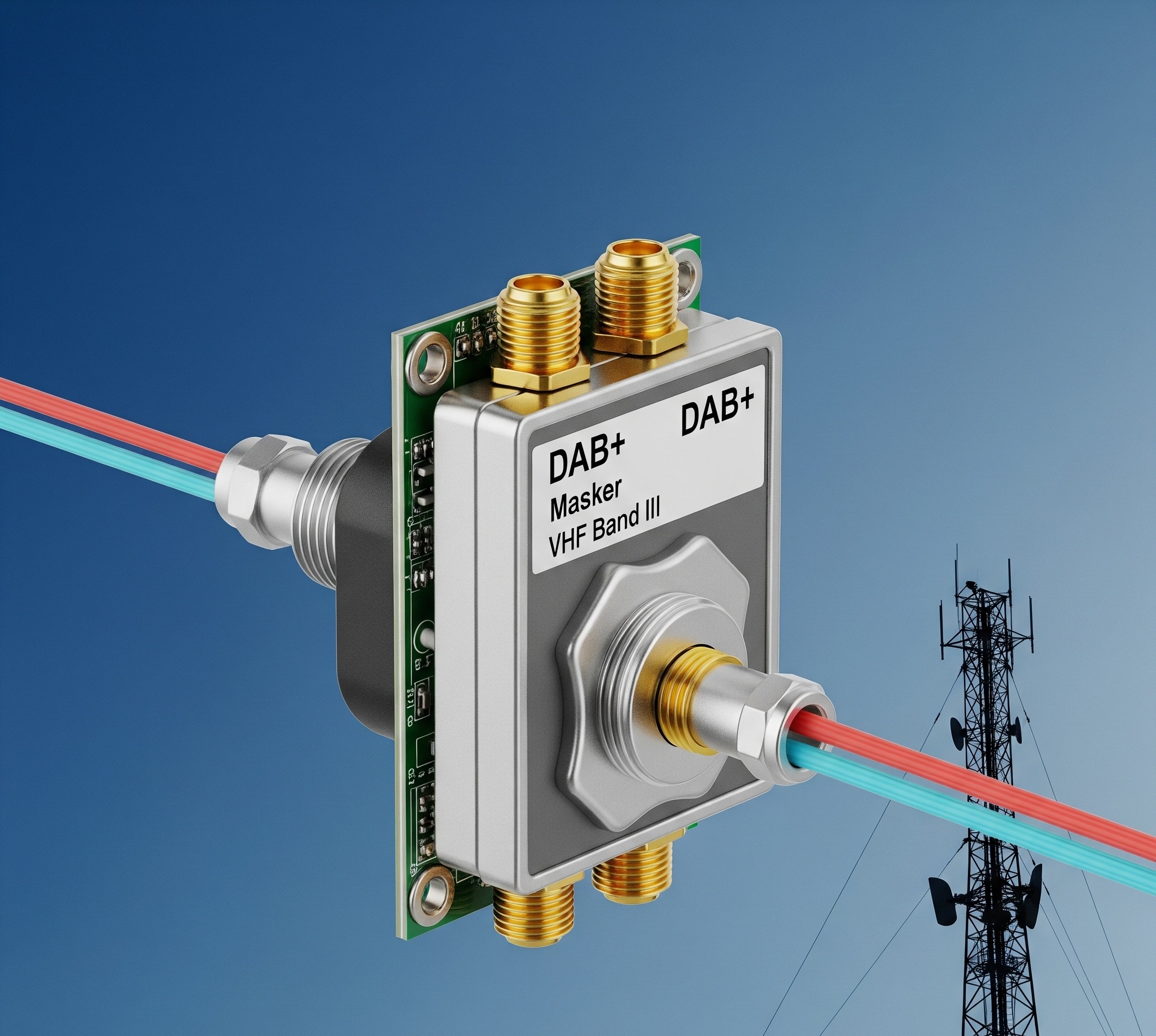
A DAB Plus band-pass mask filter is a specialized RF component used in Digital Audio Broadcasting (DAB and DAB+) to comply with emission standards and reduce interference. Here is an overview of its purpose, functionality and importance:
Objective:
-
Regulation compliance:
The filter ensures that the transmitter meets emission requirements, as set out in ETSI EN 302 077, so that there is no interference with adjacent channels or other services. -
Signal Shaping:
The filter ensures that the transmitted RF signal remains within spectral limits (e.g., 1.536 MHz bandwidth), minimizing out-of-band emissions. -
Interference Suppression:
Reduces unwanted emissions and harmonics generated by the transmitter, and protects other RF systems in nearby frequency bands.
Key features:
- Frequency range: Typically 170–240 MHz (VHF Band III), configurable for the specific channel of use.
- Insertion Loss: Designed to minimize signal attenuation, typically around 0.5–1 dB.
- VSWR (Voltage Standing Wave Ratio): Provides good impedance matching, usually lower than 1.5:1.
- Power handling: Supports transmission power from a few watts (low power transmitters) to several kilowatts (high power transmitters).
- Temperature stability: Reliable operation under varying conditions (e.g. -10°C to +50°C).
Types of mask filters:
-
Fixed band-pass filter:
Tuned to a specific frequency range, suitable for single-channel operations. -
Tuneable band-pass filter:
Adjustable for different frequencies, ideal for multi-channel or flexible applications. -
Integrated filters:
Some transmitters have built-in band-pass mask filters for a compact setup.
When to use a band-pass mask filter?
- When used in environments with other RF systems to prevent channel crosstalk.
- To comply with permits or regulations for DAB+ broadcasts.
- To ensure high signal quality and maintain the integrity of the DAB+ broadcast.
Installation considerations:
- Placement: Install the filter between the RF output of the transmitter and the antenna system.
- Tuning: Make sure the filter is tuned to the operating frequency of your DAB+ channel.
- Power Specification: Make sure the filter can handle the transmitter power of the transmitter.
Investing in a high-quality DAB+ band-pass mask filter will ensure you comply with regulations, minimize interference and improve overall broadcast performance.