
Information guide: Legal Broadcasting with an Event Channel
When you invest in high-quality broadcast equipment for an event, it is essential that the legal preconditions are properly arranged. In the Netherlands, regulations are strict: without the correct permits, a channel is seen as an illegal pirate, resulting in high fines and confiscation of equipment.
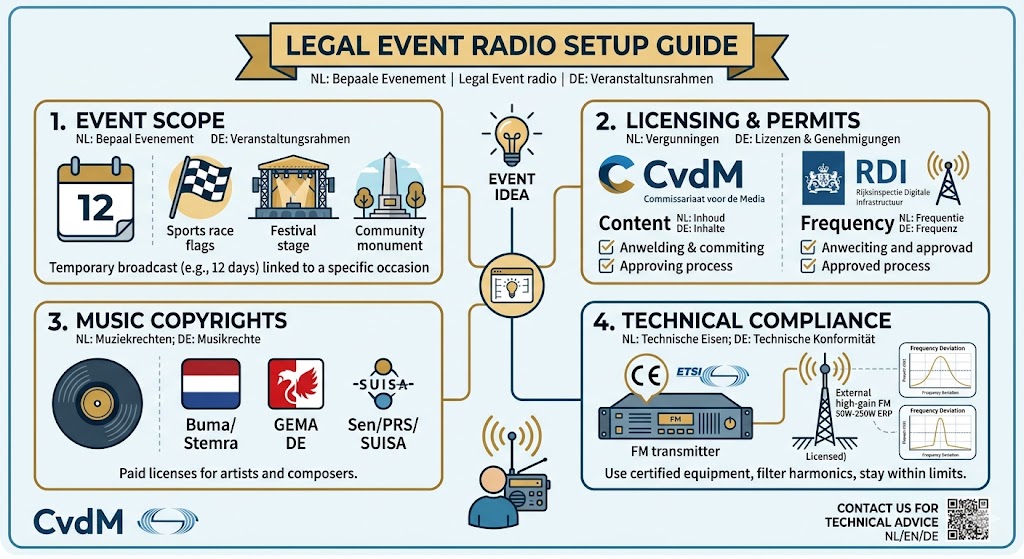
Follow this step-by-step plan to get your event station up and running legally.
1. The Basics: When is it an event?
An event permit is intended for short-term broadcasts (maximum 12 days) that are directly linked to an event, such as:
-
A sports tournament or car rally.
-
A local festival or village festival.
-
A commemoration or cultural event.
2. Step 1: Permission from the Dutch Media Authority (CvdM)
Before you can apply for a frequency, the CvdM must assess whether you are allowed to act as a broadcaster.
-
Request: You are requesting a 'direction' for the specific event.
-
Content: You must demonstrate what the program offering is and how it relates to the event.
-
Costs: Please take into account the legal handling costs (fees).
3. Step 2: Frequency space at the National Digital Infrastructure Inspectorate (RDI)
As soon as the permission from the CvdM has been received, you can apply for the actual broadcasting license from the RDI.
-
Technical parameters: You must specify which transmitter and antenna arrangement you are using.
-
Power & Location: Based on your location, the RDI determines which FM frequency is available and which maximum power (ERP) you may use to prevent interference with national stations.
-
Term: Submit the request at least 8 weeks before the start of the event.
4. Step 3: Music copyrights (Buma/Stemra & Sena)
Having a broadcasting license does not mean that you can play just any music.
-
Buma/Stemra: Compensation for the makers (composers/lyricists).
-
Sena: Compensation for the performers and producers.
-
Event rate: There are specific licenses for temporary events that are often cheaper than annual licenses.
5. Step 4: The Technical Installation
Make sure your equipment meets the essential requirements of the RDI:
-
Certified transmitters: Only use equipment with a CE mark that complies with ETSI standards.
-
Interference-free: Use good filters and high-quality coaxial cables to avoid harmonic pollution outside the assigned frequency.
-
Antenna placement: Please note the local APV (General Local Regulation) for the installation of temporary masts.
Useful links for your request:
Tip from our experts: The RDI regularly carries out checks during events. Make sure that you always have the permit papers with the transmitter and that your wave (modulation) remains within the legal standards.
Would you like advice on which transmitter or antenna setup is most suitable for your licensed power? Contact us for tailor-made technical advice.